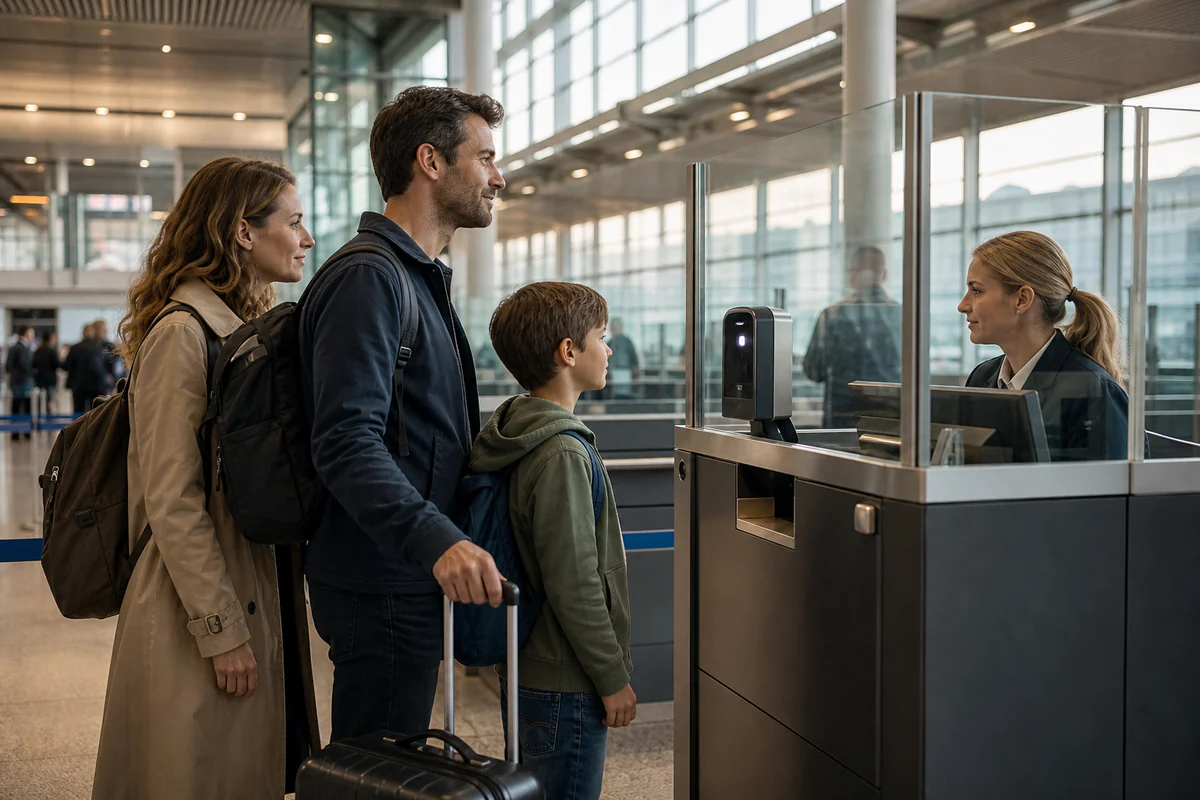
No. Children under 12 are exempt from giving fingerprints even when EES applies to them. The system can still record the child's facial image, passport details, and entry or exit event.
This guide was checked against the official EES FAQ, the EES Regulation, and EU agency material on August 3, 2026.
The fingerprint exemption does not remove the child from EES
The official EES FAQ states that fingerprints of children below 12 are not scanned even when those children are subject to EES. Source 1
The legal basis says the same thing. Article 17 of Regulation (EU) 2017/2226 requires an individual file for visa-exempt third-country nationals in scope and exempts children under 12 from the requirement to give fingerprints. Source 2
That is a biometric-data exemption, not a blanket EES exemption. A child can be registered without a fingerprint scan.
What EES can record for a child
The European Commission describes EES as recording the travel-document data, biometric data, and entry and exit data of short-stay non-EU travellers who are in scope. Source 3
The EES Regulation lists the individual-file and crossing data. Depending on visa status and the applicable procedure, that includes:
- name, date of birth, nationality, and sex;
- travel-document type, number, issuing country, and expiry date;
- a facial image;
- the date, time, and border crossing point of an entry or exit;
- any refusal-of-entry record created under the Regulation.
Those categories are set out in Articles 15, 16, 17, and 18 of Regulation (EU) 2017/2226. Source 2
For a visa-exempt traveller aged 12 or over, the official FAQ says EES normally stores four fingerprints and a facial image. For a traveller who needs a short-stay visa, it says EES stores the facial image because fingerprints were already registered during the visa application. It then states the under-12 fingerprint exception. Source 1
The practical answer for a child under 12 is therefore not "no biometrics." It is "no EES fingerprint collection," while a facial image can still be part of the EES file.
Why a border officer may take a photograph but no fingerprints
The Regulation treats facial images and fingerprints as distinct biometric identifiers. Article 15 provides for a live facial image when an individual file is created or the image is updated. Article 17 separately exempts children under 12 from fingerprints. Source 2
This explains a border process in which the child's face is captured but no fingers are placed on a scanner. The two steps do not have the same age rule.
EU-LISA, the European Union agency that operates large-scale justice and home-affairs systems, also identifies children under 12 as a main category exempt from EES fingerprinting. Source 4
Check whether the child is exempt from EES for another reason
Age alone does not create a complete EES exemption. However, a child may fall outside EES registration because of residence status, nationality, or family-member documentation.
The European Commission says non-EU family members of an EU, Icelandic, Liechtenstein, Norwegian, or Swiss citizen are exempt when they hold the relevant residence card or permit. Without that residence document, a non-EU family member can be registered in EES. Source 5
The Commission also says holders of long-stay visas or residence permits issued by a country operating EES are not registered, while holders of those documents issued by Cyprus or Ireland are registered. Source 5
Read the EES residence-permit and long-stay-visa guide before assuming the fingerprint age rule is the only relevant exemption.
What to record when travelling with a child
Keep a separate chronological record for each traveller, including each child. For an external border crossing, record:
- The child's passport and its issuing country.
- The local entry or exit date.
- The country and border crossing point.
- Whether a facial image was captured.
- Whether fingerprints were requested or not requested.
- Any visa, residence card, residence permit, or long-stay visa presented.
- Any written correction, refusal, or explanation received from the border authority.
Do not merge the child's presence dates into a parent's record. Immigration permissions and EES files are attached to individual travellers and travel documents. A family can cross together while each person has a different passport, visa, residence document, or EES treatment.
For Schengen planning, keep the actual entry and exit dates even when no passport stamp is added. EES became fully operational at external border crossing points on April 10, 2026 and replaced passport stamping for travellers in scope. Source 3
Frequently asked questions
Are children under 12 completely exempt from EES?
No. The official FAQ says they are exempt from fingerprint scanning even if they are subject to EES. A separate residence, family, or nationality exemption may remove them from EES registration. Source 1
Can EES take a facial image of a child under 12?
Yes, when the child is subject to EES. The Regulation requires facial-image data in the relevant individual file while separately exempting children under 12 from fingerprints. Source 2
Does no fingerprint scan mean the crossing was not recorded?
No. EES can record the travel document and entry or exit event without collecting the child's fingerprints.
Should a child have a separate travel-day record?
Yes. Record each person's passport, documents, and actual border dates separately so a later review does not assume every family member had identical status.
Jetseen is a recordkeeping and calculation tool, not legal, tax, or immigration advice.
References
Disclaimer: This article is for informational purposes only and does not constitute legal or tax advice. Tax residency rules change frequently. Consult a qualified tax professional for advice specific to your situation.